
 Available in US
Table of Contents
The Legal Landscape Behind Australia’s Casino Games
Australia’s gambling law is less a single rulebook than a division of labour. The Commonwealth sets boundaries for interactive services, while states and territories regulate much of the gambling conducted within their own jurisdictions. There is no single overarching gambling statute and no one gambling authority supervising every product from one office. The arrangement is federal by design, though it can feel rather less elegant from the player’s side.
That distinction matters because the legal status of a gambling product depends not only on what it is, but also on how it is supplied. A casino-style game in a physical venue is not treated in exactly the same way as the same game delivered through an online service. The Interactive Gambling Act 2001 is the central federal instrument for the online question. It makes it illegal for gambling providers to offer certain online services to people in Australia.
The important word is provider. The Act is directed principally at the business offering the service, not at the individual who attempts to use it.
This index highlights notable casino options for Australian players, with attention to licensing, bonuses, deposit requirements and payout details where available. Use the listed facts to identify which operators best match your preferences.
License: Curacao eGaming Licence · Min. deposit: A$20 Skycrown Casino operates under a Curacao eGaming Licence and has a minimum deposit of A$20.
License: Curacao eGaming Licence · Min. deposit: A$10 PlayWest is licensed by Curacao eGaming and sets its minimum deposit at A$10.
Bonus: up to A$750 + 50 jackpot spins, 35x wagering · Payout speed: crypto ~90 minutes, fiat 1-5 days · Min. deposit: A$30 Kingmaker offers up to A$750 plus 50 jackpot spins with 35x wagering. Crypto payouts take around 90 minutes, while fiat payouts take 1–5 days; the minimum deposit is A$30.
License: Curacao (operating since 2017) · Bonus: 250% up to A$2,000 + 50 free spins on the first of six deposits · Min. deposit: A$20 Uptown Pokies has operated under Curacao licensing since 2017. Its first of six deposits can qualify for a 250% bonus up to A$2,000 plus 50 free spins, with a A$20 minimum deposit.
License: Curacao · Bonus: up to A$10,000 multi-stage + 500 free spins · Min. deposit: A$20 (POLi) Lucky Dreams is licensed by Curacao and features a multi-stage bonus of up to A$10,000 plus 500 free spins. The minimum deposit is A$20 when using POLi.
License: Curacao eGaming (Roby Games Ltd) · Bonus: 100% up to A$750 + 200 free spins Roby Casino operates under Curacao eGaming licensing through Roby Games Ltd. Its offer includes a 100% bonus up to A$750 plus 200 free spins.
License: Curacao · Bonus: 100% up to A$500 + 200 free spins, 10x wagering · Payout speed: crypto 30-60 minutes, fiat 1-5 days · Min. deposit: A$10 Wild Tokyo is Curacao-licensed and offers a 100% bonus up to A$500 plus 200 free spins with 10x wagering. Crypto payouts take 30–60 minutes, fiat payouts take 1–5 days, and the minimum deposit is A$10.
License: Curacao eGaming OGL/2024/923/0383 (Antillephone N.V.) · Bonus: up to A$2,000 + 100 free spins across 2 deposits · Min. deposit: A$30 WinSpirit Casino holds a Curacao eGaming licence, OGL/2024/923/0383, issued through Antillephone N.V. Its offer reaches A$2,000 plus 100 free spins across two deposits, with a A$30 minimum deposit.
License: Curacao · Bonus: up to A$2,000 Golden Pokies operates under Curacao licensing and offers a bonus of up to A$2,000.
Bonus: up to A$7,500 + 550 free spins across 10 deposits, 50x wagering · Payout speed: crypto under 1 hour, PayID 1-3 business days · Min. deposit: A$20 (A$30 to qualify for the bonus) Ricky Casino offers up to A$7,500 plus 550 free spins across 10 deposits, with 50x wagering. Crypto payouts take under an hour, PayID payouts take 1–3 business days, and the minimum deposit is A$20, or A$30 to qualify for the bonus.
What the Interactive Gambling Act prohibits
Online casino games offered to an Australian customer fall within the category of “prohibited interactive gambling services”. The category includes familiar products:
- pokies;
- roulette;
- blackjack;
- live-dealer casino tables.
In ordinary language, these are the games most people would recognise as casino games, whether the graphics are digital or a dealer appears through a live video stream. The technology changes the setting, not the legal character of the service. A roulette wheel rendered on a screen remains part of an online casino service; a blackjack table hosted by a live dealer does not become lawful merely because a real person is dealing the cards.
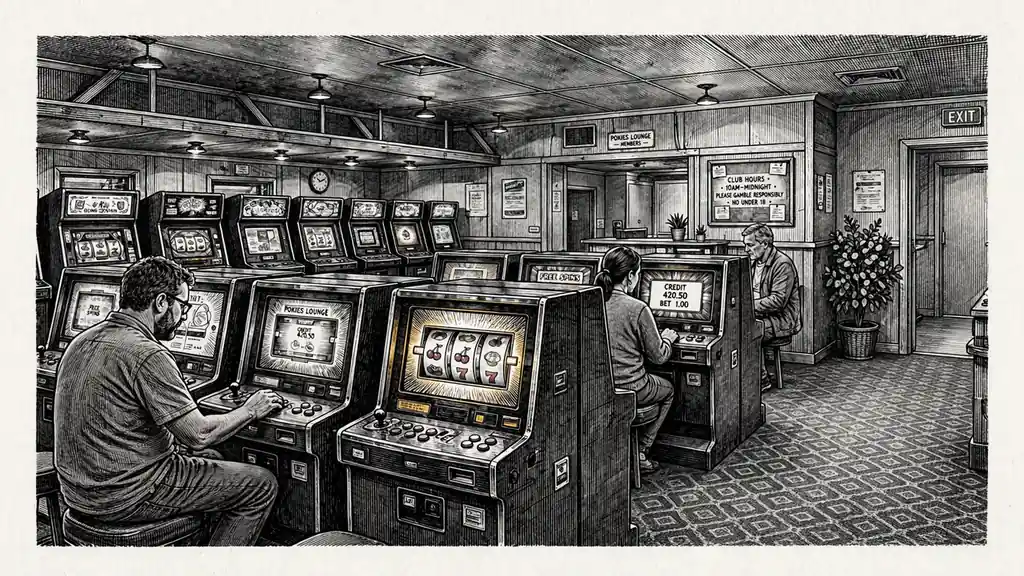
The same applies to pokies. The Australian term is not decorative slang: it is the everyday name for electronic gaming machines. In an online setting, pokies are among the casino-style products that cannot lawfully be offered to Australian customers.
This is a prohibition on provision, rather than a domestic licensing route waiting to be discovered. The federal framework does not create an Australian licence for an online casino offering these games. A provider cannot turn a prohibited service into a lawful one simply by describing itself as international, offshore or entertainment-focused.
The boundary is therefore substantive. It is not a warning about poor-quality operators, nor a temporary administrative gap. The product itself, when supplied online to an Australian customer, falls within the prohibited category.
Federal rules and state responsibility
The federal and state or territory roles overlap in the wider gambling system, but they are not interchangeable.
At federal level, the Interactive Gambling Act addresses interactive gambling services supplied to people in Australia. The Australian Communications and Media Authority, or ACMA, monitors compliance with and enforces Australia’s interactive gambling laws. Its work concerns the online supply chain and the services made available through the internet.
States and territories retain responsibility for much of the licensing and supervision of gambling within their borders. That includes gambling products that the law permits to operate under local authorisation. Online sports betting, for instance, is legal and licensed at state and territory level. Race wagering is also part of the regulated wagering landscape.
This does not mean that a state or territory licence for wagering can be stretched to cover casino games. A licence for one product is not a general permission for every gambling product. Sports betting occupies one legal category; online pokies, roulette, blackjack and live-dealer tables occupy another.
That is the point at which casual language creates trouble. “Licensed gambling” sounds like one broad field, but Australian law treats it as a collection of distinct activities, divided between regulators and jurisdictions. A lawful sports-betting service does not thereby become a lawful casino. A local authorisation connected with race wagering cannot be presented as authority to provide online roulette.
Different rules. Different products.
Why the player and the provider are treated differently
The Interactive Gambling Act targets the provider rather than the player. Australians are not committing a crime merely by placing bets at offshore sites.
That distinction should not be mistaken for approval. The absence of a criminal offence for the player does not create a right to receive the service, and it does not make an offshore casino an Australian-licensed operation. It simply identifies where the Act places its primary legal force: on the business offering the prohibited interactive gambling service.
This approach reflects a familiar regulatory instinct. The state can pursue the commercial supply of a service more directly than it can police every individual interaction with a website. It also avoids turning the customer into the principal wrongdoer when the commercial operator controls the platform, the terms and the availability of the games.
The practical message is narrower than either extreme. An Australian customer is not committing a crime by placing a bet at an offshore site, but the provider is not thereby permitted to offer prohibited online casino games to Australians. One fact does not cancel the other.
Casino games are not sports betting
The contrast with online sports betting is especially important because both activities are often grouped under the loose heading of “online gambling”. The law does not treat that label as decisive.
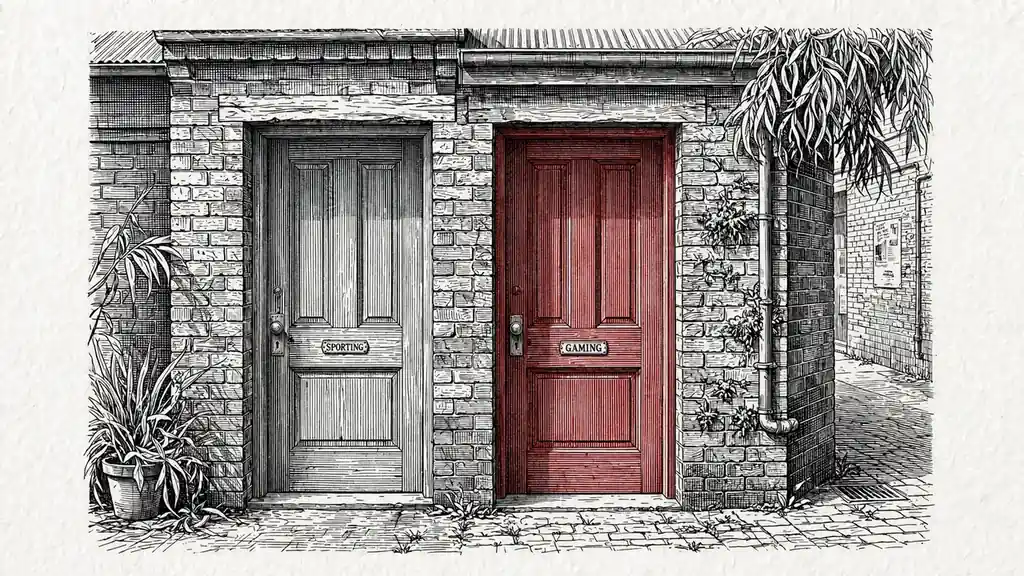
Online sports betting is legal where the operator holds the relevant state or territory licence. Online casino games are prohibited when supplied to an Australian customer. The difference is not a matter of whether the account is registered in Australia, whether the website uses Australian currency, or whether the platform also offers a lawful wagering product. It follows from the type of gambling service being supplied.
A business may therefore operate in a regulated wagering market without being entitled to offer casino games online. The lawful status of one part of its business cannot be used as a passport for another. Gambling regulation is fond of compartments; websites are fond of menus. The menu does not rewrite the statute.
The role of enforcement
ACMA’s role gives the federal prohibition an operational edge. The agency can direct internet service providers to block sites operating in breach of the Interactive Gambling Act. Site blocking does not change the underlying classification of a game, but it shows how the federal framework is enforced beyond the wording of the Act.
The legal landscape is consequently built from two layers. The first identifies which online services may be supplied to Australians. The second determines how access to services operating in breach can be restricted. State and territory regulators continue to oversee permitted gambling products under their own licensing structures, while the federal framework addresses prohibited interactive services.
For casino-style products, the conclusion is direct. Online pokies, roulette, blackjack and live-dealer tables are prohibited interactive gambling services when offered to Australian customers. The provider carries the legal risk under the Interactive Gambling Act 2001; the player is not committing a crime simply by placing a bet offshore. State and territory licensing does not convert those casino games into lawful online services.
Bonuses and Promotions Under Australian Gambling Rules
A bonus is never merely a bonus in gambling regulation. It is also an inducement, an advertisement, and sometimes evidence of how a service is trying to reach a particular audience. In Australia, that distinction matters because promotional language can create a compliance problem even before anyone considers the attractiveness of an offer.
- Focus on licensed wagering services like sports and racing
- Verify offshore licences via the issuing regulator’s own register
- Use official resources like BetStop for harm reduction
- Assume an offshore licence makes a casino lawful in Australia
- Treat promotional inducements as proof of legality
- Use credit cards or cryptocurrency for gambling deposits
The first line is the status of the underlying product. Online casino games offered to Australian customers are prohibited interactive gambling services under the Interactive Gambling Act 2001. That includes online pokies, roulette, blackjack and live-dealer tables. A sign-up offer cannot change that legal position. Nor can a label such as “international”, “offshore” or “welcome promotion”. Packaging an unlawful service in a more cheerful sentence does not make it lawful.
This is why bonuses and promotions should not be treated as a shopping category for Australian customers. Publishing a list of offers, comparing sign-up incentives or encouraging account registration could promote a prohibited service. The issue is not whether the bonus has attractive wording. The issue is whether the wording helps provide, market or facilitate a gambling service that cannot lawfully be offered to people in Australia.
Inducements are part of the regulatory picture
An inducement is designed to influence conduct. In gambling, that may mean opening an account, depositing funds, returning to a service, placing a wager or referring another person. Promotional language often makes that intention obvious: “join”, “claim”, “deposit”, “play”, “redeem” and “invite” are not neutral verbs when connected to gambling.
That does not mean every discussion of a promotion is automatically the same legal matter as the underlying gambling product. It means the promotion cannot be assessed in isolation. A service that is already prohibited cannot become acceptable because its advertising is presented as a separate marketing campaign. The bonus is part of the route by which the service seeks customers.
The same logic applies to content that appears informational but functions as advertising. A page may avoid a direct instruction to register and still present an offer in a way that encourages participation. Repeating a promotional code, describing the steps for claiming a reward or framing an offshore casino as an available option can move the material away from neutral explanation and towards facilitation.
A disclaimer does not repair every problem. “For information only” cannot neutralise a page whose practical purpose is to direct Australian customers towards prohibited online casino gambling. Dry legal language has limits. Marketing remains marketing when placed in a legal costume.
Advertising restrictions are not the same as game legality
Australia’s gambling rules distinguish between products that may be licensed and products that may not be offered online to Australian customers. Online sports and race wagering can be licensed at the state and territory level. Online casino games cannot be offered in the same way. The regulatory question for a promotion therefore begins with the product being promoted, not with the size or style of the incentive.
This prevents a common category error. A lawful wagering operator may still face restrictions on how it advertises inducements. Conversely, a foreign online casino does not acquire an Australian permission merely because it advertises responsibly, displays a foreign licence or limits the language used in its offer. Promotion does not create a licence.
The ACMA monitors compliance with and enforces Australia’s interactive gambling laws. Its role is particularly relevant where promotional material appears to connect Australian users with services operating in breach of the Interactive Gambling Act. ACMA can direct internet service providers to block sites operating in breach of that law. The consequence is practical as well as legal: a promotional presence can become part of the evidence that a service is attempting to reach the Australian market.
Why wording matters
Promotional wording can reveal an intended audience. References to Australian dollars, Australian payment arrangements, local sporting events, Australian time zones or “Aussie” customers may make the targeting plain. Even without those signals, an offer displayed beside Australian-specific content can give the promotion a local commercial context.
The wording also affects the impression created about legality. Calling an offshore casino “licensed for Australians” is misleading if the licence is foreign and the product cannot lawfully be offered domestically. Describing a bonus as “safe”, “approved” or “regulated in Australia” can create the same false impression. ACMA is not an approval badge for online casinos, and a foreign regulator does not authorise service to Australian residents.
Legal Prohibition Online casino products like pokies, roulette, and blackjack are prohibited interactive gambling services under the Interactive Gambling Act 2001.
Promotional claims can mislead in less dramatic ways. “Risk-free”, “guaranteed”, “instant” and “no-strings-attached” suggest certainty or simplicity that gambling rarely provides. A bonus may carry conditions, and the surrounding advertisement may omit material limits. Even where the underlying product is within a lawful category, an inducement can raise consumer-protection concerns if its presentation obscures what participation involves.
That is where gambling regulation and general consumer law begin to overlap. The Australian Competition and Consumer Commission is concerned with misleading conduct and deceptive representations across markets. A promotion that suggests government approval, conceals its commercial purpose or presents an unlawful service as locally available can attract scrutiny beyond gambling-specific enforcement.
Responsible coverage without promotion
A responsible explanation of bonuses should describe the regulatory problem, not reproduce the sales pitch. It can identify inducements as a compliance issue, explain why advertising may help regulators establish targeting, and distinguish lawful wagering promotions from prohibited online casino offers. It should not supply a sign-up path, a referral link, a bonus code or instructions for bypassing Australian restrictions.
The same caution applies to comparisons. A table ranking welcome bonuses would not become neutral merely because it included a warning beneath it. The visual structure would still direct attention to offers and encourage selection. In this market, the safest editorial boundary is clear: discuss the rules, not the bargains.
For people affected by gambling harm, BetStop – the National Self-Exclusion Register™ and Gambling Help Online provide support and self-exclusion information. Those services belong to harm reduction, not promotion. Keeping that distinction visible matters because gambling language often borrows the tone of ordinary retail: a reward, a deal, a limited opportunity. The product may look like commerce. The consequences are less tidy.
Promotional compliance therefore cannot be reduced to deleting a few extravagant adjectives. It requires asking what is being promoted, whom the material reaches, what impression it creates about legality, and whether the content helps an Australian customer access a prohibited service.
The offer is not the loophole.

Payments and Withdrawals: Where the Money Trail Leads
Money is often the clearest record of how gambling reform changes behaviour. Rules may be written in statutes and explained in policy language, but their practical effect appears when a deposit is attempted, a withdrawal is delayed, or a transaction is refused before it reaches an offshore service.
That distinction matters in Australia. Payment information cannot turn a prohibited online casino into a lawful one, and a successful transfer does not amount to regulatory approval. The transaction is only one part of the picture. The legal status of the gambling service comes first.
Deposits are not a shortcut around the rules
Australian gambling regulation does not treat the payment rail as a magic tunnel through which an otherwise prohibited service becomes acceptable. Online casino games, including pokies, roulette, blackjack and live-dealer tables, are prohibited interactive gambling services when offered to Australian customers. Moving money to such a service does not change that classification.
The Interactive Gambling Act 2001 is directed primarily at providers rather than players. Australians do not commit a crime merely by placing bets at offshore sites. That does not make offshore casinos a protected or authorised destination. It means the legal burden falls chiefly on the business offering the service, while the customer remains exposed to the practical consequences of using a market that Australian law does not license.
Those consequences can begin before any game is played. A payment may be rejected, reversed, held for review or become difficult to trace. None of those outcomes proves that a provider is lawful, and none creates a right to access online casino games in Australia. It is a dry arrangement: the money may move, but the legal ground does not move with it.
Australian reforms also prohibit credit cards and cryptocurrency as deposit methods for online gambling. The point is not merely technical. Credit-funded gambling separates the moment of play from the moment of financial pain, while cryptocurrency can make the path of funds harder for ordinary consumers to understand. Removing those routes narrows the ways in which gambling can be financed and gives payment controls a role in harm reduction.
Withdrawals reveal the real relationship
Depositing is the easy part of a gambling transaction. Withdrawal is where the relationship is tested.
A service may accept money readily and become less cooperative when funds are requested back. Verification questions, identity checks and account reviews can appear at that stage. In a regulated domestic market, those processes sit within a framework of licensing, supervision and consumer obligations. For an offshore casino serving Australians without an Australian casino licence, the position is less reassuring. A foreign licence, where one exists, does not authorise the operator to serve Australian customers.
This is why the money trail should not be read as a consumer recommendation. A familiar payment brand, a functioning cashier or a completed withdrawal says nothing conclusive about the legality of the underlying service. It confirms only that a transaction occurred. A receipt is not a licence.
The same caution applies to disputes. When a withdrawal fails, the available remedies may depend on the operator’s jurisdiction, its terms and the payment provider’s procedures. The existence of a foreign regulator may offer a route for a complaint about that foreign licensee, but it does not convert the service into an Australian-licensed casino. The boundary remains stubbornly unglamorous.
Why the reforms focus on the provider
The regulatory design reflects a practical problem. An online service can be located overseas while marketing to people in Australia, accepting Australian currency or processing Australian payments. Chasing every individual customer would be a poor substitute for controlling the businesses that supply the service.
The ACMA monitors compliance with and enforces Australia’s interactive gambling laws. It can direct internet service providers to block websites operating in breach of the Interactive Gambling Act. Blocking does not inspect every payment individually, but it interrupts the commercial path by which a provider reaches Australian customers.
The available figures show the scale of that intervention, although the published accounts do not align perfectly. One reported position states that, as of August 2025, ACMA had blocked 1,296 illegal sites and affiliates since 2019. Another figure, stated as of March 2026, records 1,564 illegal gambling and affiliate websites blocked. These are different reporting points, so they should not be blended into a single timeless total.

The same source material also describes more than 220 illegal gambling services as having voluntarily exited the Australian market following ACMA action, while another formulation says that over 220 online gambling services have withdrawn since the reforms. The wording and reference point differ. The direction is clear; the accounting is not identical.
Payment restrictions and website blocking work together. One makes funding routes narrower. The other makes access less direct. Neither is a promise that every attempted transaction will fail, and neither should be mistaken for personal financial protection. A blocked website can be replaced by another. Money can still be lost through services based outside Australia.
The cost of a growing segment
Online gambling is the fastest-growing gambling segment. That growth helps explain why payments have become part of the regulatory argument rather than a neutral technical detail. A digital service can be available beyond ordinary trading hours, promoted across borders and connected to payment systems without a physical venue. The distance between impulse and transaction becomes very short.
The broader figures also require careful handling. Australia reported approximately $32 billion in gambling losses during 2022–2023. Another cited account puts Australians’ losses on legal forms of gambling at approximately $25 billion each year. These figures describe different scopes and periods, and the available sources do not reconcile them into one definitive national measure. Presenting either number as the universal total would create false precision.
Sports and race betting are permitted under specific state and territory licences.
Online pokies, roulette, blackjack, and live-dealer tables cannot be lawfully offered to Australians.
Reports nevertheless indicate that the amount of money lost on gambling services based outside Australia has reduced since the reforms. That is an important result, but not a declaration that financial harm has disappeared. Losses can shift between products, jurisdictions and payment channels. A reduction in offshore losses may coexist with substantial domestic losses and continuing pressure on households.
The human story is often hidden inside aggregate totals. A blocked payment is visible to a system. A missed bill, a secret account or an argument at home is not. Financial controls can reduce access to a prohibited service, but they cannot by themselves resolve gambling harm. BetStop – the National Self-Exclusion Register™ and Gambling Help Online exist within that wider harm-reduction landscape, where the problem is treated as more than a failed transaction.
Reading a payment event accurately
A payment outcome supports only a narrow conclusion:
- a declined deposit means that particular route did not complete;
- a processed deposit means funds reached the recipient or its payment intermediary;
- a pending withdrawal means the funds have not yet been returned;
- a completed withdrawal means money was paid out through that route.
None of these outcomes establishes that an online casino is legal in Australia. None proves that an operator is approved by ACMA. None turns a foreign licence into an Australian licence.
That is the essential money trail. It can show where funds travelled and where the system interrupted them. It cannot redraw the boundary set by Australian gambling law.
Online Casinos in Australia: A Market That Cannot Be Licensed Domestically
Australia’s online casino market has an awkward legal shape: the demand exists, but the domestic licence needed to serve it does not. There is no domestically licensed real-money online casino for Australian players. That is not a temporary gap between one regulatory regime and the next. It is the direct result of the way Australian law separates permitted wagering from prohibited online casino services.
The distinction matters because the word casino can make several different activities sound like one market. A licensed venue may offer gambling in a physical setting, while an online operator offering pokies, roulette, blackjack or live-dealer tables to an Australian customer falls into a different legal category. The digital version is not simply a land-based casino moved onto a website. Legally, the move changes everything.

Why a domestic online casino licence does not exist
Only local operators holding relevant licences may offer gambling products to Australian residents. For online casino games, however, there is no Australian gambling licence available. Offering that product to Australians is against the law, so an operator cannot obtain a domestic authorisation by meeting ordinary licensing conditions and paying the appropriate fee. The licence is absent because the service itself is outside the permitted market.
This is why descriptions of the Australian market sometimes become misleading. A website may describe itself as licensed in another country, but that foreign authorisation does not become an Australian casino licence by appearing in a footer. Nor does an offshore business become locally authorised merely because it accepts Australian currency, displays Australian imagery or has Australian customers.
The legal boundary is therefore structural:
- real-money online casino games are not available from a domestically licensed Australian operator;
- casino games offered online to Australians cannot be treated as an approved local gambling product;
- the lawful online market is centred on licensed sports and race wagering, not casino play.
There is no domestic equivalent of an Australian online casino licence waiting to be checked. A neat badge cannot manufacture one.
The market Australia does licence
Australia does licence certain forms of online wagering. Sports betting and race betting are permitted within state and territory regulatory arrangements, subject to the relevant licence structure. This produces a market that can look broad from the outside while remaining narrow in legal terms.
Queensland illustrates the point. There is no current holder of an interactive gambling licence in Queensland. At the same time, UBET QLD Limited is currently the exclusive licence holder for race and sports wagering in the state. Those facts should not be treated as contradictory. They describe different regulatory positions and different kinds of authorisation.
The Queensland example also shows why the phrase “licensed online gambling” requires more precision. A licence connected with race and sports wagering does not authorise online roulette, blackjack or pokies. The product is part of the licence. A wagering authorisation cannot be stretched into a casino permission simply because both involve money and odds.
The same caution applies nationally. A licensed bookmaker is not an online casino operator. A race-wagering service is not a casino platform. A state or territory approval for one product does not carry across to another.
Why search results can make the market look larger
The internet does not arrange itself according to Australian legal categories. Offshore casinos may still publish pages aimed at Australian audiences, and search results may present them beside licensed wagering services. Their presence can create the impression that Australia has a functioning online casino market with several competing local providers.
It does not.
An offshore casino may hold a foreign licence, but that licence does not authorise it to serve Australian customers. It is also not evidence that an Australian gambling licence exists for casino games. The language used by operators can blur this distinction: “available in Australia”, “accepting Australian players” and “licensed casino” may appear in the same paragraph, although each statement belongs to a different legal question.
The important question is not merely whether a site can be reached from Australia. It is whether the operator is legally permitted to provide the service to people in Australia. For online casino games, the answer cannot be supplied by pointing to a domestic licence, because no such licence exists.
That leaves Australian players in a peculiar position. The provider is the target of the prohibition, not the player. Australians are not committing a crime merely by placing bets at offshore sites. But this does not transform an offshore casino into a lawful Australian service, and it does not give the player the protections associated with a locally regulated product.
A market divided by product, not by branding
The cleanest way to understand the landscape is to ignore branding and classify the underlying activity.
Sports and race wagering may be supplied by operators holding the relevant local licences. Casino-style online games — including pokies, roulette, blackjack and live-dealer tables — do not enter the same permitted category when offered to Australian customers. The difference is not cosmetic, and it is not resolved by calling a game “entertainment”, “international” or “licensed overseas”.
This product-based approach is less glamorous than a list of casino brands, but it is more accurate. The legal market is not a menu in which every gambling product is available from a different provider. It is a boundary. Some services may be licensed; others cannot be licensed domestically at all.
That boundary also explains why comparing Australian online casinos by local licence, local regulation or domestic consumer approval leads nowhere. There are no domestically licensed real-money online casinos to compare. The relevant licensed market is wagering on sports and races.
What the absence of a licence says about the market
The absence of domestic online casinos is a policy choice expressed through law. It says that Australia has not treated every form of digital gambling as a normal extension of an existing venue. Instead, it has allowed some wagering products under state and territory supervision while excluding online casino games from the lawful domestic offering.
This arrangement may feel untidy, especially where a physical casino and an online bookmaker exist within the same broad gambling economy. But regulation often reveals what a society is willing to separate. Australia separates casino-style online play from licensed online wagering, even though both can be marketed through screens and settled electronically.
The result is a market with a legal centre and an unlawful-looking fringe: licensed race and sports wagering on one side, offshore casinos seeking Australian attention on the other. The fringe may be visible, searchable and commercially polished. It is still not domestic licensing.
For that reason, “online casinos in Australia” is best understood as a description of a prohibited service category, not as a catalogue of Australian-licensed operators. The legal market offers licensed sports and race wagering. It does not offer a domestically licensed real-money online casino.
Licences, Registers and the Limits of Casino Safety Claims
A licence is a legal instrument, not a mood. It does not make a gambling service safe merely because its logo appears on a website, and it does not give an overseas operator permission to serve Australian customers. In Australia, that distinction is especially important because no domestic gambling licence authorises online casino games for Australian residents. The country’s licensed online market is limited to permitted wagering products, not real-money casino games.
Summary
- There is no domestic licence for real-money online casinos in Australia.
- ACMA focuses enforcement on providers rather than individual players.
- A foreign licence does not grant permission to operate within the Australian market.
- Regulatory compliance is determined by the product type, not the branding.
That makes licence language unusually easy to misuse. An offshore casino may display a licence from Malta or Curaçao, but that foreign authorisation is not an Australian casino licence. It does not displace the Interactive Gambling Act 2001, and it does not turn a prohibited interactive gambling service into a lawful one.
The label can travel. The permission cannot.
What an Australian register can and cannot show
The Australian Communications and Media Authority, or ACMA, publishes a register of Australian-licensed interactive wagering service providers. This is useful evidence of licensing for the categories that Australia permits to be offered under the relevant state, territory and federal arrangements.
It is not a register of domestically licensed online casinos. No such category exists for real-money pokies, roulette, blackjack or live-dealer tables offered to Australian customers. A name appearing in an Australian wagering register therefore cannot be treated as proof that the same business may provide casino games. A licence has a scope, and the scope is the part that promotional pages tend to leave in the smallest type.
The regulatory structure also matters. Australia has no single overarching gambling statute or gambling authority. Responsibility is divided between federal law and state or territory regulation. ACMA monitors compliance with and enforces Australia’s interactive gambling laws, while state and territory bodies administer the licences available for lawful wagering products. The result is not a universal Australian approval stamp. It is a collection of permissions attached to specific products and jurisdictions.
For casino claims, the practical rule is blunt: an Australian wagering licence cannot be stretched into an Australian online-casino licence.
Checking a foreign licence without mistaking it for permission
Offshore operators commonly refer to licences issued in Malta or Curaçao rather than an Australian casino licence. Those authorities maintain public registers in which a licence number and its status can be checked. Cross-referencing the number is worthwhile when assessing whether the claimed foreign authorisation exists, is current and belongs to the stated company.

That check answers a narrow question:
Does the overseas regulator recognise this operator?
It does not answer the larger Australian question:
May this operator lawfully provide online casino games to Australian customers?
The answer cannot be supplied by a Malta Gaming Authority or Curaçao register. A foreign register verifies the relationship between an operator and a foreign regulator. It does not confer authority under Australian law.
Licence verification should therefore be read as identification and oversight information, not as a safety certificate. A genuine licence may indicate that the operator has entered a foreign regulatory framework. It may also provide a route for complaints or enforcement within that framework. But it does not guarantee that funds will be recovered, disputes will be resolved in Australia or Australian consumer protections will apply. Nor does it erase the legal risk attached to the service being offered locally.
A badge is not a border crossing.
The difference between oversight and safety
“Licensed” is often used as if it were a synonym for “safe”. It is not. Regulation can impose rules, record obligations and create supervisory powers, but a licence does not remove every risk associated with gambling, identity checks, withdrawal disputes, data handling or business failure. Safety claims need to be narrower than the word itself.
That is particularly true when an operator is outside Australia. The relevant regulator may be overseas, the applicable complaints process may be unfamiliar and the legal route for challenging a decision may not be practical for an Australian customer. Even where a foreign register confirms the licence number, the register does not establish that the service is lawful in Australia.
The scale of regulatory intervention shows why a public badge should not settle the matter. ACMA reported that it had blocked 1,296 illegal sites and affiliates since 2019 as of August 2025. A later figure says that, as of March 2026, ACMA had directed internet service providers to block 1,564 illegal gambling and affiliate websites. These figures do not align, and the difference should be stated rather than quietly resolved: they may reflect different reporting dates, counting methods or categories, but the available facts do not establish which explanation applies.
The consistent point is the enforcement activity itself. More than 220 illegal gambling services have voluntarily exited the Australian market following ACMA action. A site remaining accessible at a particular moment is therefore not proof of legality, permanence or regulatory approval.

Why affiliate claims deserve caution
Licence information is frequently repeated by affiliates, comparison pages and promotional material. Repetition can make a claim look independently confirmed when it is merely copied. The original regulator’s register is stronger evidence than a logo supplied by the operator or an article repeating the operator’s own description.
The same discipline applies to claims about “Australian compliance”, “government approval” or “ACMA licensing”. ACMA is the authority that enforces interactive gambling law; it is not an Australian casino licensing body. An operator cannot be presented as ACMA-licensed or ACMA-approved merely because ACMA has published enforcement information about it, or because a site uses Australian language and accepts Australian visitors.
Australian residents are not committing a crime merely by placing bets at offshore sites under the Interactive Gambling Act’s provider-focused approach. That fact should not be turned into an invitation. It describes where the law places responsibility; it does not promise that an offshore service is secure, lawful to provide or supported by Australian consumer remedies.
Risk information belongs beside licence information
The personal consequences of gambling are not made irrelevant by regulatory vocabulary. A single profile-style review, rather than an official national estimate, gives problem gambling prevalence as between 0.5% and 1.0%, with a further 1.4%–2.1% at risk of developing problems. Because the figures come from that type of source and the population being described is not established here, they should not be presented as a settled market-wide measure.
The responsible conclusion is narrower. Licensing status and gambling harm are different questions. A regulator’s register may help establish whether a stated licence exists; it cannot determine whether gambling is affordable, controlled or harmless for a particular person. Where gambling begins to feel difficult to stop, BetStop – the National Self-Exclusion Register™ and Gambling Help Online provide relevant Australian support pathways.
Verification is useful. It is not absolution.
For Australian online casino claims, the order of checks is therefore straightforward:
- Identify the product being offered.
- Establish whether Australian law permits that product to be offered to Australian customers.
- Check the operator’s stated licence number in the issuing regulator’s public register.
- Treat a foreign licence as foreign oversight, not Australian permission.
- Separate evidence of registration from claims about safety, fairness or consumer protection.
- Give enforcement and harm-reduction information the same prominence as the licence claim.
A register can confirm a number. It cannot rewrite the law.
Written by the editors at Casino Info Au.